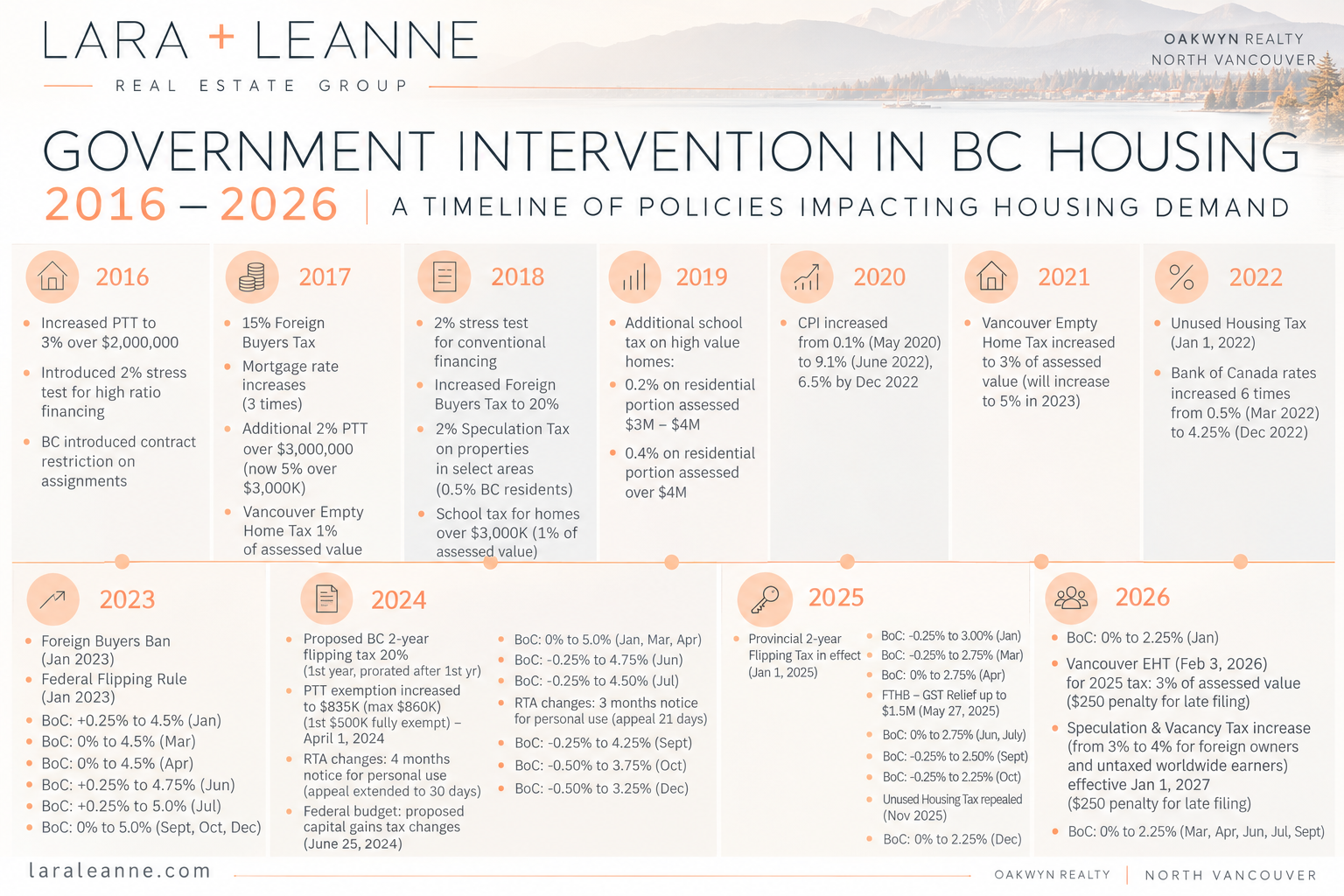
Over the past decade, British Columbia's housing market has been subjected to an extraordinary number of government interventions. From foreign buyer taxes and mortgage stress tests to speculation taxes, vacancy taxes and flipping restrictions, governments have repeatedly introduced measures intended to improve housing affordability.
But have these policies actually helped?
The unintended consequences are becoming increasingly difficult to ignore.
Since 2016, buyers have faced increasingly complicated mortgage qualification rules, additional taxes and rising borrowing costs. Meanwhile, sellers and investors have encountered new restrictions, increased expenses and greater uncertainty.
Making It Harder to Buy
Mortgage stress tests were introduced to protect borrowers from taking on excessive debt. While they have strengthened financial stability, they have also reduced purchasing power for many qualified buyers.
For first-time buyers, particularly in expensive markets like North Vancouver and West Vancouver, qualifying for a mortgage can remain challenging even when housing prices decline.
More Taxes, More Uncertainty
Foreign buyer taxes, speculation and vacancy taxes, additional property transfer taxes and flipping taxes have all added layers of complexity to the housing market.
Although these measures were intended to discourage speculation, they can also influence legitimate investment decisions, discourage transactions and create uncertainty for property owners.
When investors become reluctant to purchase or develop housing, there can also be consequences for future rental supply.
The Interest Rate Shock
Perhaps the most significant impact on housing demand came from the Bank of Canada's rapid interest rate increases beginning in 2022.
Higher borrowing costs dramatically reduced purchasing power, forcing many buyers to reconsider their plans.
Even as home prices softened, higher mortgage payments meant affordability did not necessarily improve.
Have We Addressed the Real Problem?
Government intervention has focused heavily on controlling housing demand. Yet one of British Columbia's greatest challenges remains the availability of housing.
Taxes and restrictions cannot create the homes our growing communities need.
While some policies have successfully reduced speculative activity and protected borrowers, the cumulative effect of repeated intervention deserves closer examination.
After ten years of additional regulations and taxes, housing affordability remains a serious challenge.
Perhaps it's time to shift more attention toward increasing housing supply, reducing development costs and making it easier to build the homes British Columbians need.
Lara + Leanne Real Estate Group
Oakwyn Realty | North Vancouver